
_edited.png)


What Is Residential Security and a Residential Security Team (RST)?


Residential Security is the active security management of a private residence to reduce exposure risk, ensure the protection of the people, the property, and assets inside whilst maintaining privacy using licensed operatives, security systems, and operational procedures to control access, monitor activity, and prevent, detect, and respond appropriately to threats.
*This typically involves a full-time 24/7 presence. In larger properties or estates, this may be an on-site team managing from an internal control room or gatehouse. In smaller residences such as apartments or even city townhouses where space in limited operatives can be predominantly based externally in a vehicle for example, while still maintaining control of access, systems, and activity.
A Residential Security Team (RST) is a dedicated team of SIA-licensed (Security Industry Authority) Close Protection Operatives assigned to a private residence, providing continuous oversight of access, systems, and day-to-day activity within the property.
What Does a Residential Security Team Actually Do?
A Residential Security Team (RST) is responsible for controlling access, monitoring and managing activity, and responding to any threats while blending into the principals lifestyle and household dynamics.
Most properties already have alarms, CCTV, and access systems in place. The issue typically is not usually what exists, but how it is used. Systems get installed, but over time they are relied on rather than managed. Alarms are not set consistently. Cameras are reviewed after something happens, not during. Access is assumed rather than checked.
Residential security closes that gap. It combines trained operatives, systems, and procedures to ensure the property is actively controlled day to day. That means knowing who is coming and going, what is happening inside the property, and being able to respond immediately when something does not align with what is expected.
This obviously includes monitoring CCTV and alarm systems, but most of the role has very little to do with staring at screens. It is about actively maintaining control of the environment. Knowing who and what is on site at all times, why they are there, and whether they have been properly vetted and verified.
In practical terms, the role of a Residential Security Team (RST) usually includes things like:
Regular internal and external patrols
Immediate response to threats based on SOPs (Standard Operating Procedures)
Monitoring and maintaining CCTV, lighting and alarm systems
Controlling access at all entry points
Managing and screening deliveries / mail
Logging and searching staff and contractor bags
Keeping track of who is on site at all times
Greeting and escorting guests, staff, and contractors
Supervising contractors to prevent issues or disputes
Checking doors, windows, and access points
Managing lighting, curtains, and signs of occupancy whilst property is unoccupied
Answering the phone
Monitoring for and reporting maintenance issues
Managing People Within The Property: Visitors, Guests, Contractors and Staff

Most exposure in residential environments does not come from unknown individuals. It comes from people who are allowed in.
Guests, contractors, cleaners, maintenance staff.
Throughout the day, residential security operatives will greet and log visitors, confirm identities, and escort guests, staff, and contractors through the property.
Over time, familiarity builds. People stop being checked. Access becomes informal. That is usually where control starts to drift.
A Residential Security Team reintroduces structure without making the environment feel restrictive.
Visitors are expected. If someone arrives unannounced, it is dealt with rather than assumed. Contractors are supervised, not because they are suspected of wrongdoing, but because accountability matters.
It is not uncommon, for example, for a contractor to accidentally damage something and not report it. Or to take photos of the property and share them. These are not always malicious acts, but they create unnecessary exposure.
At any given moment, there is a clear understanding of who is on site, what they are doing, and how long they are expected to remain. Contractors and tradespeople are never left to work unsupervised. They are escorted, their work is observed, and any issues are addressed immediately. This not only prevents damage or disputes, but also removes the uncertainty that often comes later when no one is quite sure what was done, or by whom.
Access points are monitored and controlled continuously, with doors, windows, gates, and entry routes checked. While physical security systems such as CCTV systems, various intruder alarms, lighting, locks and even fire systems are consistently monitored and maintained, not simply relied upon to work when needed.
Access & Movement Control
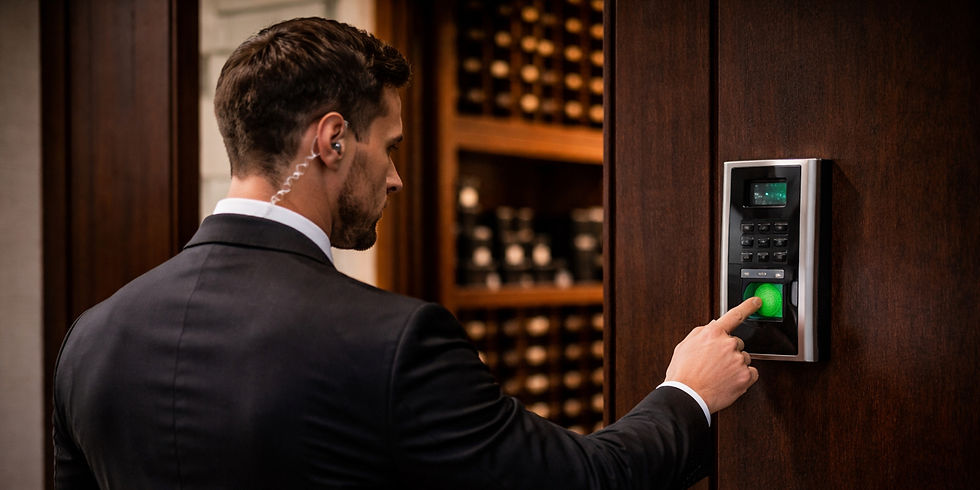
Access control is managed. Visitors are expected, verified, logged and accounted for. Contractors are supervised, and records are maintained so there is always a clear understanding of who has been in the property and why. This alone significantly reduces the likelihood of theft, damage, trespass, or dispute.
Access control is not just about preventing entry. It is about maintaining clarity and control over time. In most households, access does not fail suddenly. It drifts.
A spare key is given out. An alarm code is shared. A contractor is allowed access “just for today”. Over time, these small decisions accumulate, and eventually no one has a clear picture of who can access the property, when, or how.
Over time, most households lose a clear understanding of who has access to the property. Keys are shared, alarm codes are passed around, and familiarity replaces scrutiny. Nothing appears wrong, but control has quietly been lost.
A Residential Security Team brings that back under control, not by restricting movement unnecessarily, but by structuring it properly. Access becomes deliberate again. Visitors are expected and verified before entry. Movement through the property is managed rather than assumed. There is a clear understanding of who is on site at any given time and what level of access they should have.
Not everyone requires access to every area. In some larger residences, or households with multiple staff and contractors, access is often zoned. Certain areas remain private, while others are designated for staff or external work. This can be managed physically, or through systems such as controlled entry points and biometrics where appropriate.
For example, a contractor may be given access to a specific part of the property for a defined period, but not the ability to move freely throughout the residence. Without that structure, it is common for individuals to unintentionally move beyond where they were expected to be.
Over time, these boundaries become part of standard operating procedures. Access levels are defined, exceptions are controlled, and changes are recorded rather than informally agreed.
Patrols & Checks
There is naturally a consistent physical presence across the property there to prevent, detect, and respond to threats. Internal and external patrols are carried out as part of standard operating procedures (SOP’s). This includes everything from checking access points and perimeter / border checks to making sure the property is secured.
A property that is actively patrolled behaves very differently to one that isn’t. Patrols are not just about walking the property. They are used to confirm that everything is as it should be and, just as importantly, to challenge what isn’t.
That includes properly checking access points properly, not just visually. Doors are tested, not assumed to be locked. Gates are confirmed to close and latch correctly. Alarm states are verified rather than taken for granted.
Over time, operatives build a clear picture of how the property should feel. What time certain lights are usually on, which areas are typically in use, how the property sits at different points in the day.
That’s what makes changes stand out.
A door that’s been left unlocked. A window slightly open that shouldn’t be. A side gate that’s been used when it normally isn’t. These are often the result of everyday behaviour like a contractor in a rush finishing work, a staff member leaving in a hurry, but they create exposure if they’re not picked up.
It removes reliance on “someone else probably did it”.
As part of the SOPs patrols aren’t always carried out in the same way or at the same time. Good patrols vary slightly. Different routes, different timings, occasional additional checks. Not enough to disrupt the household, but enough that patterns don’t form.
That unpredictability matters.
A property that is checked the same way at the same time every day becomes easy to understand from the outside. A property that isn’t predictable is far harder to read.
Deliveries, Mail, Post & Incoming Items

Deliveries are one of the easiest ways for routine to weaken control within a property.
In many households, parcels are left at the door, handed to staff, or brought inside without much thought. Over time, this creates a pattern where delivered items and delivery drivers enter the property without being properly checked, verified, or accounted for.
Deliveries are managed deliberately. All deliveries and drivers are received, verified, screened and logged. Expected items are received properly. Unknown or unexpected deliveries are questioned before being accepted and incoming items are screened and logged so there is clear accountability around what entered the property, who received it, and where it was taken afterwards.
High-value residences often receive large volumes of parcels, sensitive documents, specialist consignments, and items of significant value. Without structure, it becomes easy for things to be misplaced, accepted by the wrong person, or brought into the property without anyone really knowing what they are.
It is also common for deliveries to create unnecessary access. A driver arrives earlier than expected. A package is quickly signed for by staff out of convenience. Someone is allowed closer to the residence than they need to be. None of this appears significant in isolation, but it gradually weakens control.
A properly managed approach keeps the process simple. Deliveries are received in the right place, by the right person, with the right level of scrutiny. The aim is not to create friction, but to ensure that nothing enters the property unchecked and nothing creates unnecessary opportunity.
This ensures there is no ambiguity around what has entered the property, who received it, and where it has gone. This becomes particularly important in higher-value residences, where items of significance, sensitive materials, or high volumes of deliveries are common.
Privacy, Discretion & Visability
Privacy is often compromised in small, unintentional ways.
A contractor sees something they should not or notices artwork or valuable items. A delivery driver may see inside the property when a door is left open. A casual conversation from staff may reveal when the house will be empty.
A Residential Security Team (RST) prevents that by controlling not just access, but visibility. Sensitive areas can be restricted. Movement within the property is managed so that people only see what they need to or are supposed to see.
Where appropriate clients may also impose contractors, staff, guests or all external parties to sign Non Disclosure Agreements (NDAs) and Confidentiality Agreements, but more importantly, their presence is managed in a way that reduces what they are exposed to in the first place.
Privacy is not protected by agreements alone. It is protected by control. Nothing is seen, heard, or shared that should not leave the property.
People are not simply allowed to move freely through the property. Movement is managed so individuals only see what they need to see. Contractors are kept within defined areas. Sensitive rooms, offices, or storage spaces remain restricted unless access is required.
It is also about how people behave while they are there. Phones come out. Photos get taken. Conversations get overheard. Without structure, this happens naturally. With the right oversight, it doesn’t.
Practical Value & General Benefits

Some of the value in residential security sits outside of what would typically be considered “security”.
Because someone is consistently present and paying attention, issues are picked up early and reported, often before they become visible to anyone else.
A small leak under a sink. A fault developing in an electrical system. A fire risk building in an area that isn’t regularly used. These are not unusual, but without oversight they often go unnoticed until they become disruptive or expensive.
It is not uncommon, for example, for contractors to complete work and leave something slightly off. A valve not fully closed, a system not reset, or an access point left unsecured. In many properties, those details are not identified until much later.
Over time, this can save significant cost. Not through major incidents, but by identifying small issues early before they escalate into something far more serious.
There is also a practical, day-to-day element.
While the primary role remains security, having a trusted presence on site means the property continues to function properly, which can even extend to feeding pets occasionally where appropriate while staff are unavailable or the property is unoccupied.
It is not about replacing household staff. It is about ensuring the property remains controlled, maintained, and looked after at all times.
When Residential Security Becomes a Consideration
Residential security is not always necessary.
However, there is usually a point where the way a property is managed no longer matches how it is actually being used.
This tends to show up in practical ways:
the property is left empty more often or for longer periods
travel becomes predictable or publicly visible
more staff, contractors, or third parties are regularly on site
keys, codes, and access permissions have been shared over time
the property becomes higher profile, higher value, or more exposed
personal wealth increases, often bringing more valuable assets into the property and a higher level of visibility
items such as vehicles, watches, artwork, or collections begin to accumulate, sometimes without any change in how the property is secured
At that point, residential security becomes a sensible consideration, not necessarily because of a single incident, but because the public profile, personal wealth increase or property have outgrown an informal approach.
A Professional Starting Point
For most homeowners, the first step is simply understanding where they stand.
Our Confidential, Free 30-Minute, No Obligation Residential Security Consultation gives you a clear view of how your property is currently operating from a security perspective. This includes identifying where control may have drifted, where exposure to risk has increased, and whether your current approach is still proportionate to your lifestyle, profile, and assets.
In many cases, clients leave the call with a clearer understanding of what is working, what is not, and whether any security solutions after that are required at all.
Where appropriate, this is followed by a complimentary, no obligation site survey conducted by one of our residential security consultants. This allows the property to be assessed in context, including access points, routines, visibility, and how the residence is actually used day to day.
From there, a bespoke residential security solution can be developed based on your risk profile, property, lifestyle, and your specific requirements.
There is no obligation to proceed, but it does help ensure any threats and risks are fully understood and any decisions are made early, with clarity, rather than later in a reactionary fashion under pressure.


